


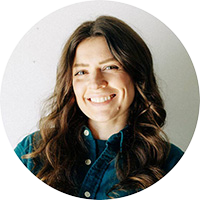
Dr. Winslow D. Hansen
Forest Ecologist
|
PhD, University of Wisconsin, Madison
Expertise
forest ecology, social-ecological resilience, natural disturbance
External site: www.forestfutureslab.org | Profile (pdf)
845 677-7600 x138
- Profile
- Videos & Podcasts
- Publications
- People
Forests influence climate and sustain life globally. Trees sequester carbon emissions that cause climate warming, support much of the planet’s biodiversity, and provide essential services such as fuel, food, and clean water and air. Due to climate change, increasing disturbances, and deforestation, many forests are threatened. Winslow Hansen works to understand where and why forests are at risk, and how we can avoid catastrophic losses.
Hansen uses experiments and field observation to reveal how forests are responding to environmental change. He is also developing novel techniques that integrate remote sensing and computer simulations to model forest response – scaling from individual trees up to entire biomes. Together, these complementary approaches paint a picture of current and future forest health across backyards, watersheds, and the planet.
This science is relevant to managers and policy makers tasked with stewarding forests during a time of profound change. Hansen often brings stakeholders into his research process so that results are immediately injected into decision making. For instance, he worked with managers at Grand Teton National Park to evaluate whether different management strategies might reduce wildfire risk to people and help conserve some of America’s last remaining wildlands. Hansen is building on this work to determine where people and forests may be most threatened by fires across the western United States, including California.
Hansen is Director of the Western Fire and Forest Resilience Collaborative, which brings together 10 premier research teams to advance a fire science agenda co-developed with decision makers. By weaving together fieldwork, remote sensing data, and state-of-the-art modeling, the Collaborative will ensure the best science guides fire policy, management, and community adaptation.
Kate Amato - Program Manager
Kate provides administrative support to Dr. Winslow and is the Project Manager for the Forest Futures Lab and the Western Fire & Forest Resilience Collaborative.
Prior to joining Cary Institute, she spent 10 years in the special event industry in which she owned and operated a sustainable floral design business in the Hudson Valley. Kate has a background in art administration with a focus on public art and gallery exhibitions. She holds a B.A. in art history and a M.A in museum studies from Marist University. In her free time, Kate enjoys oil painting and camping in the Adirondacks.
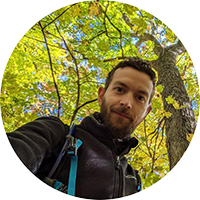
Quinn Asena - Data Scientist
Quinn is interested in ecological dynamics and mechanisms that underlie change in ecosystems overtime and space. His main research focus is around biotic interactions and how ecosystems respond to environmental and climate change. Much of his previous research focused on long-term ecological trajectories and palaeoecology. Currently, Quinn is exploring contemporary ecosystem change through process-based models.
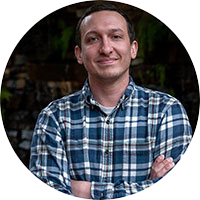
Sam Flake - Postdoctoral Associate
Sam is an ecologist with broad research interests in vegetation dynamics, disturbances, and landscape ecology. He has studied drought mortality in the western USA (during his MS studies at the University of Nevada - Reno) and fire in Brazilian savannas (during his PhD at North Carolina State University), and used simulation modeling to assess vegetation responses to climate change, management, drought, and fire across the USA (during a postdoc also at NCSU).
As a postdoc in the Forest Futures Lab at Cary Institute, Sam is modeling forest responses to management and fire in the Colorado Rockies, in order to better understand how forest dynamics are connected to the hydrology of the headwaters of the Colorado River.
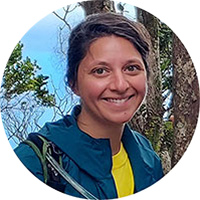
Nichole Gange - Senior Program Manager & Outreach specialist
Nichole provides program management and outreach of Dr. Hansen’s Western Fire & Forest Resilience Collaborative research group at Cary Institute. She coordinates teams of scientists, conducts outreach, manages administration and operations.
Prior to joining Cary, she worked for various government agencies and non-profits as an Interpretive Naturalist. Nichole has managed visitor centers, facilitated restoration projects, coordinated events, developed interpretive signage and delivered programs to the public and government staff. Nichole has volunteered organizing and presenting at regional workshops and national conferences with the National Association for Interpretation. Nichole has a Bachelor of Science Degree in Environmental Management & Protection: Interpretation & Environmental Education from Cal Poly Humboldt.
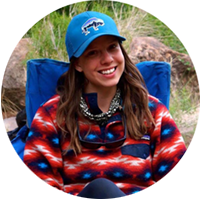
Jazlynn Hall - Research Associate
Jazlynn is a forest and landscape ecologist at the Cary Institute of Ecosystem Studies. She studies how disturbances like fire and deforestation influence forest carbon sequestration in the western United States and seeks to identify management solutions for maximizing ecosystem services in current and future forest systems.
Before her appointment at Cary Institute, Jazlynn received her PhD in ecology and evolutionary biology from Columbia University. Her dissertation research drew from principles in ecology, hydrology, and geography to determine the effects of forest disturbance from extreme events on carbon sequestration and streamflow in Puerto Rico. She holds a BS in Geography and a BA in Anthropology from the University of Wyoming. Jazlynn is a reading enthusiast, burgeoning forager and weekend backpacker.
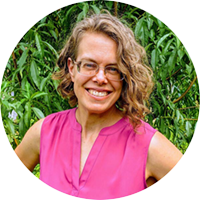
Lora Murphy - Programmer
Lora is a research support professional specializing in data analysis, code writing of all kinds, GIS, and high performance computing applications. In her over 20 years in the field, she has contributed to various projects including the creation of the SORTIE-ND forest model, forecasting climate change effects on forests of the eastern US, modeling light availability in agroforestry applications, and government-sponsored efforts to control forest pathogens in both the US and Canada. She has run code on everything from 10-year-old laptops to national supercomputers.
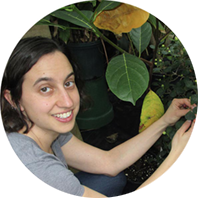
Manette Sandor - Research Associate
Manette is a community and quantitative ecologist at the Cary Institute of Ecosystem Studies. Her research is focused on how climate change, management, and feedbacks influence forest and fire dynamics in the western United States.
Prior to joining Cary Institute, Dr. Sandor was a Postdoctoral Fellow at Columbia University as well as a Visiting Scientist at the American Museum of Natural History in the Center for Biodiversity and Conservation. Before that, she was a Postdoctoral Scholar at Landscape Conservation Initiative at Northern Arizona University (now the Center for Adaptable Western Landscapes). Her postdoctoral research had two foci: the socioecological repercussions for changing fire regimes in the Sonoran Desert and anthropogenic impacts on mutualist interactions (seed dispersal and pollination). She received her M.Sc. in plant ecology and Ph.D. in ecology and evolutionary biology from the University of Connecticut.
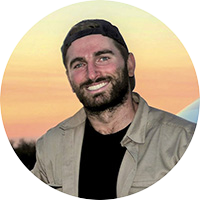
Jay Schoen - Data Scientist
Jay Schoen is a spatial ecologist with broad experience in geospatial data analysis, remote sensing, and wildlife ecology research. His research addresses ecological questions and conservation objectives with geospatial analyses and ecological modeling to promote landscape-scale connectivity, ecological functioning, and habitat restoration efforts. He has worked as an ecological consultant for several leading conservation organizations and holds an adjunct faculty position within Columbia University’s Ecology, Evolution, and Environmental Biology (E3B) department.
In Jay’s role as the Western Fire and Forest Resilience Collaborative data scientist, he integrates data analyses and products between scientists, teams, and stakeholders. These products are a key component of WFFRC’s objectives for science and communication with decision-makers and the public.
Growing up in southern California, Jay carries a lifelong fascination with and passion for sharing the natural world through every aspect of his work. A job at the Bronx Zoo brought Jay to New York City in 2012. After working in zoos for nearly a decade, he obtained a Masters and PhD from Columbia University’s E3B Department, during which he studied large carnivore movement ecology in central India and regions of South America. He enjoys hiking, surfing, hockey, weightlifting, and any excuse to be in nature.
Angie Wu - Field Manager
Angie assists with managing all things field campaigns! She holds a B.A. in Physical Geography and a B.S. in Molecular Environmental Biology from UC Berkeley, where she used plant functional traits and stable isotopes to research ecophysiological processes in native California tree species. Following her graduation, she worked for the National Park Service amongst the giant redwoods and dune systems of Golden Gate National Recreation Area, restoring native habitats and supporting rare plant species. In her free time, she loves paddling, trail running, and discovering new music.


